spadex mission
SPADEX Mission — The Technology That Changed India’s Space Future
For decades, rockets have been the visible symbol of space exploration. A launch lasts only a few minutes, yet some of the hardest work in space begins after a spacecraft reaches orbit. Satellites must communicate with each other, adjust their paths, and sometimes connect together while moving at enormous speeds around Earth.
That challenge became the foundation of the Indian Space Research Organisation’s SPADEX mission. Instead of focusing on another planet or a distant object in space, the mission focused on mastering orbital docking — one of the most difficult operations in modern spaceflight.
What Is the SPADEX Mission?
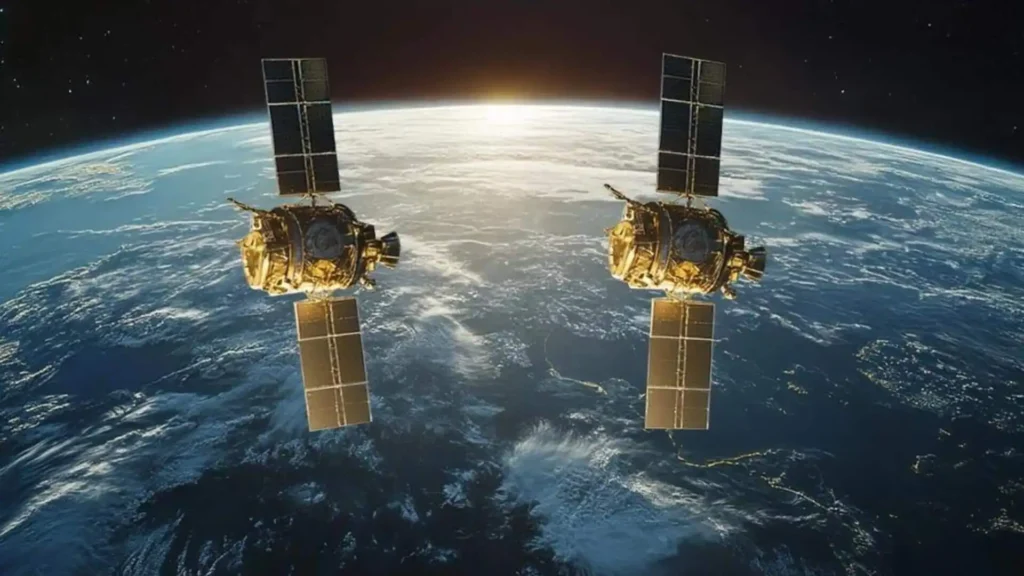
SPADEX, short for Space Docking Experiment, is an ISRO technology demonstration mission designed to test autonomous docking capability in space. The mission used two small satellites that were launched together into low-Earth orbit and later separated so they could approach and dock with each other independently.
Although the mission did not involve astronauts or planetary exploration, it carried major importance for India’s future in space. Docking technology is necessary for building space stations, transferring astronauts between spacecraft, repairing satellites, and conducting long-duration missions beyond Earth.
With SPADEX, India joined the small group of countries capable of developing indigenous space docking systems.
Why Space Docking Matters in Modern Space Exploration
Docking is the process in which two spacecraft traveling independently in orbit slowly approach, align, and physically connect with each other.
The process is far more complicated than it sounds. Both spacecraft move around Earth at nearly 28,000 kilometers per hour. In space, there is no atmosphere to slow movement or stabilize direction, so even a tiny navigation error can create serious problems.
Modern space missions depend heavily on docking technology because many large missions cannot be launched as a single spacecraft. Different sections are often launched separately and connected later in orbit. The International Space Station itself operates through repeated docking missions involving cargo vehicles and crew capsules from different countries.
For ISRO, mastering docking technology is especially important for future projects such as the Gaganyaan human spaceflight programme and India’s planned space station.
Launch Details — PSLV-C60 and Mission Timeline
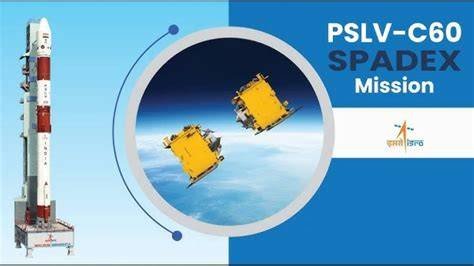
The SPADEX mission was launched aboard the PSLV-C60 rocket from the Satish Dhawan Space Centre in Sriharikota on 30 December 2024.
After launch, the PSLV rocket placed both satellites into a circular orbit about 470 kilometers above Earth. The spacecraft later separated and began a carefully planned sequence of orbital maneuvers.
The mission involved stabilizing both satellites, testing navigation systems, reducing the distance between them, and preparing for docking operations. After several controlled approach attempts, the satellites successfully docked on 16 January 2025.
With this achievement, India became the fourth country after the United States, Russia, and China to demonstrate indigenous space docking capability.
The Two Satellites: Chaser and Target Explained
SPADEX used two spacecraft with different operational roles.
The first satellite, SDX01, acted as the “Chaser.” Its task was to approach the second spacecraft using onboard sensors, navigation systems, and autonomous control software. The satellite continuously calculated distance, speed, and alignment during the approach phase.
The second satellite, SDX02, functioned as the “Target.” It maintained controlled positioning in orbit while exchanging navigation data with the chaser satellite throughout the operation.
Both spacecraft weighed around 220 kilograms, making them relatively small compared to larger international docking missions. Despite their compact size, the technology inside them was highly advanced.
The mission showed that complex orbital operations do not always require massive spacecraft.
How Docking in Space Actually Works
Space docking is often imagined as two spacecraft simply touching in orbit, but the actual process is extremely precise.
The operation begins when the satellites are separated by several kilometers. The chaser spacecraft gradually changes its orbit to reduce the distance between them. As the gap becomes smaller, onboard sensors, cameras, and laser-based systems continuously measure position and movement.
Small thrusters make tiny corrections to direction and speed. During the final stage, the spacecraft move very slowly toward each other because even a slight misalignment can damage both vehicles.
Once the alignment becomes accurate enough, mechanical docking systems connect and lock the spacecraft together.
Most of this process is controlled autonomously because communication delays make continuous manual control difficult during such delicate operations.
The Challenges ISRO Faced During Docking Attempts
SPADEX was successful, but the mission faced several technical challenges before docking was completed.
During early attempts, ISRO observed unexpected drift between the satellites. Some navigation data also showed alignment inconsistencies, forcing engineers to postpone docking operations for safety reasons.
At one stage, the spacecraft automatically entered safe mode after detecting uncertainty during close approach maneuvers. This protective response prevented the possibility of accidental collision.
These delays highlighted how sensitive docking operations are in space. Even tiny differences in speed or direction can affect the alignment process significantly.
The mission required extremely accurate orbital calculations, stable communication between the spacecraft, and highly precise thruster control. ISRO eventually refined the docking sequence and successfully completed the operation after repeated testing and system evaluation.
The mission became an important demonstration of patience, precision, and engineering discipline rather than just launch capability.
A Mission Bigger Than Its Size
SPADEX was not a giant planetary mission or a crewed flight, yet its importance is far greater than the size of the spacecraft involved.
The mission proved that India can now perform orbital rendezvous, autonomous docking, controlled undocking, and spacecraft interaction in orbit. These capabilities are essential for the next phase of India’s space ambitions.
In many ways, SPADEX represents a shift in ISRO’s journey — from simply placing satellites into orbit to managing complex operations within space itself.