A New Chapter in India’s Private Space Journey
GalaxEye and the Beginning of Mission Drishti
India’s space sector is no longer driven only by government agencies. In recent years, private startups have started building technologies that were once limited to major space organizations. One of the most promising among them is GalaxEye, a Bengaluru-based space startup founded by researchers from IIT Madras.
GalaxEye was created with a clear goal: to improve the way Earth is observed from space. Instead of depending only on traditional satellite cameras, the company wanted to build systems that could monitor the planet continuously, regardless of weather or lighting conditions.
That idea eventually became Mission Drishti, a satellite mission that introduced the world’s first operational OptoSAR satellite. The mission represents an important step not only for Indian private space companies but also for Earth observation technology itself.
The word “Drishti” means vision or sight, and the mission was designed exactly for that purpose — to give a clearer and uninterrupted view of Earth from space.
What Makes Mission Drishti Different?
Most Earth observation satellites face one major problem: they cannot always see clearly.
Traditional optical satellites capture images much like a normal camera. They provide detailed and natural-looking images, but clouds, rain, fog, smoke, or darkness can block their view completely.
Radar satellites solve this problem differently. They use microwave signals to scan the Earth and can work even during storms or at night. However, radar images are harder to interpret and usually lack the natural clarity of optical photography.
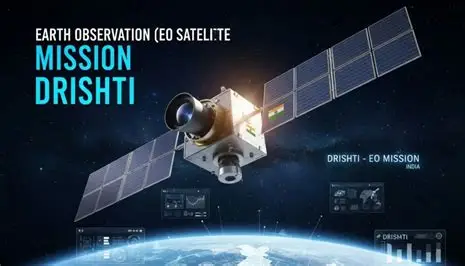
Mission Drishti combines both systems into one platform using a technology called OptoSAR.
This means the satellite can:
- Capture optical images with natural detail
- Use radar imaging during clouds or darkness
- Observe Earth continuously in different weather conditions
- Deliver more reliable monitoring data
This combination makes Mission Drishti one of the most advanced Earth observation systems developed by an Indian private company
Launch Details and Mission Specifications
Mission Drishti was launched on 3 May 2026 aboard Falcon 9 from the Vandenberg Space Force Base in California, United States.
The satellite was launched as part of a rideshare mission and successfully entered a Sun-synchronous Low Earth Orbit, allowing it to repeatedly observe the same regions of Earth under consistent lighting conditions.
Some important mission details include:
- Mission Name: Mission Drishti
- Developed By: GalaxEye
- Launch Date: 3 May 2026
- Launch Vehicle: Falcon 9
- Orbit Type: Sun-synchronous Low Earth Orbit
- Satellite Type: Earth Observation Satellite
- Technology Used: OptoSAR Imaging System
- Approximate Weight: Around 190 kilograms
The mission also received operational and tracking support from Indian Space Research Organisation and NewSpace India Limited during its early mission phase.

What Will Mission Drishti Do?
Mission Drishti was built to observe Earth with greater consistency and accuracy. Its data can support many sectors that depend on continuous monitoring.
Disaster Monitoring
Floods, cyclones, landslides, and forest fires often happen during poor weather conditions when normal satellites struggle to capture images. Since Drishti can operate through clouds and darkness, it can help authorities monitor disasters in real time.
Agriculture Observation
The satellite can help study crop conditions, soil moisture, irrigation patterns, and seasonal changes. This information may help improve agricultural planning and resource management.
Border and Maritime Surveillance
Continuous observation is important for national security. Mission Drishti can monitor border areas, coastlines, and maritime activity without interruption caused by weather conditions.
Urban and Infrastructure Planning
The mission can also assist in mapping roads, cities, railway networks, and large infrastructure projects by providing updated Earth imagery regularly.
Environmental Monitoring
Changes in forests, glaciers, rivers, and coastlines can be tracked more effectively using combined optical and radar data.
Why This Mission Matters for India
Mission Drishti is important because it shows how quickly India’s private space industry is evolving.
For decades, advanced satellite observation systems were mainly developed by government space agencies. With Mission Drishti, an Indian startup demonstrated that private companies can also build globally competitive space technologies.
The mission strengthens India in several ways:
- It reduces dependence on foreign Earth observation data
- It supports strategic and civilian applications
- It encourages private innovation in the Indian space sector
- It proves India can contribute original technologies to the global space industry
The success of Mission Drishti also reflects how collaboration between startups, research institutions, and organizations like ISRO is shaping the future of Indian space exploration.
A Mission That Looks Beyond the Clouds
Mission Drishti is more than a satellite launch. It represents a shift in how India approaches space technology. Instead of only following existing systems, companies like GalaxEye are now building technologies that attempt to solve real limitations in modern Earth observation.
.