Constellations — The Stories Humans Drew Across the Night Sky
What Exactly Is a Constellation?
On a clear night, the sky can look chaotic—thousands of stars scattered without order. Yet for thousands of years, humans looked upward and began connecting those stars into patterns. These patterns became known as constellations.
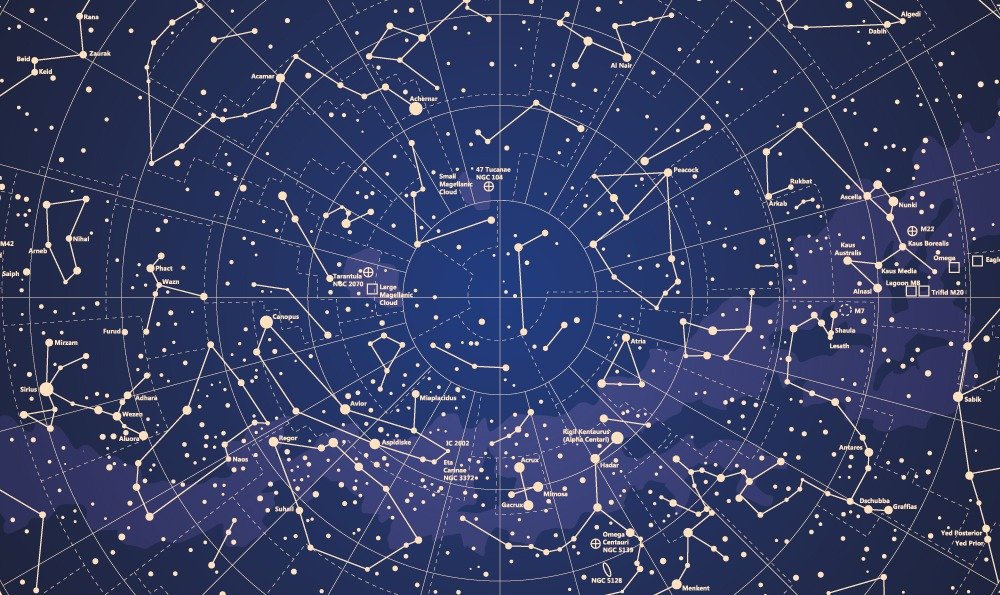
A constellation is not a real physical structure in space. It is a mapped region of the sky where stars appear to form shapes when viewed from Earth. Ancient civilizations imagined hunters, animals, gods, and mythical creatures in these star patterns long before telescopes existed.
Modern astronomy officially recognizes 88 constellations, a system standardized in 1922 by the International Astronomical Union. Today, astronomers use them like coordinates on a celestial map to locate stars, galaxies, and other cosmic objects.
The interesting part is that many stars inside one constellation are not actually close together. Some may be dozens of light-years away from Earth, while others are hundreds or even thousands of light-years farther. They only appear connected because of our viewing angle from Earth.
Misconceptions About Constellations
Constellations are surrounded by many misunderstandings, especially because astrology and astronomy are often mixed together.
Misconception 1: The Stars in a Constellation Are Physically Connected
They are not.
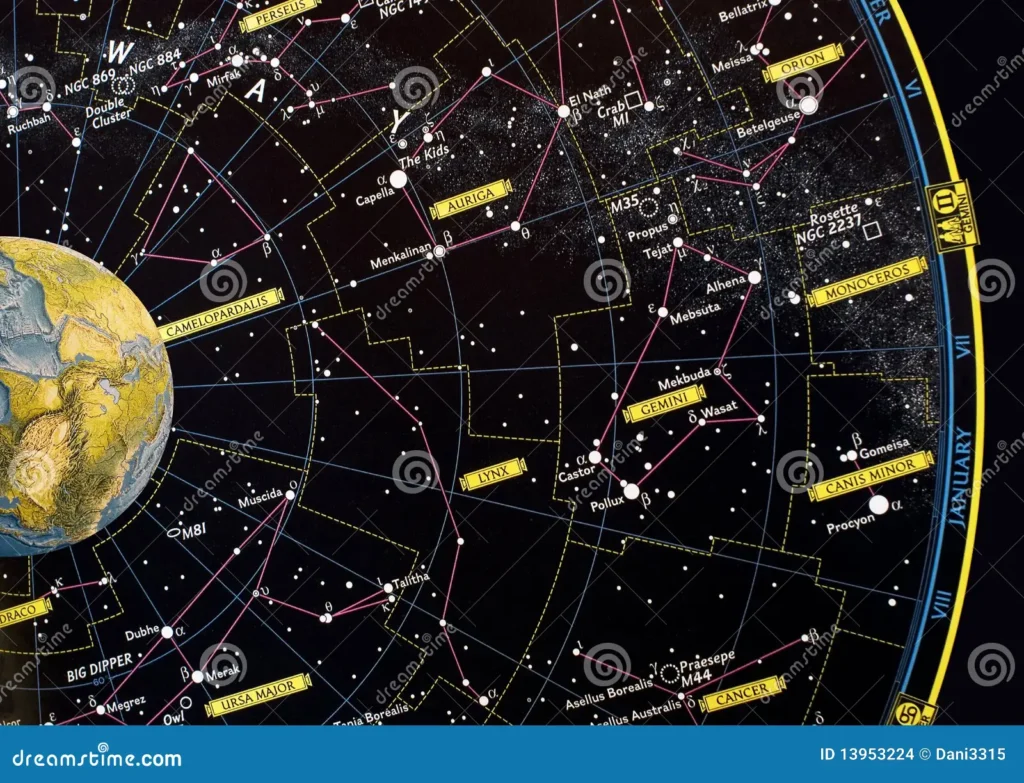
For example, the stars inside Orion lie at vastly different distances from Earth. They only appear grouped because humans observe them from one angle.
Misconception 2: Constellations Never Change
They do change—just extremely slowly.
Stars move through space over millions of years. If humans could observe the sky after 100,000 years, many familiar constellations would look distorted or completely different.
Misconception 3: Zodiac Signs Match Today’s Constellations Perfectly
This is scientifically incorrect.
Earth slowly wobbles on its axis through a process called axial precession. Because of this, the Sun’s position relative to zodiac constellations has shifted over thousands of years.
Someone considered a “Leo” today may not actually have the Sun positioned in the modern astronomical boundaries of Leo during their birth period.
Misconception 4: Ancient People Thought Constellations Controlled Human Fate
Most ancient civilizations primarily used constellations for seasonal tracking, agriculture, calendars, storytelling, and navigation. Their practical importance was often greater than mystical interpretation.
Types of Constellations and the Most Famous Ones
Constellations are usually grouped according to their position in the sky or their historical significance.
1. Zodiac Constellations
These are the constellations located along the path the Sun appears to travel across the sky, called the ecliptic. Ancient astronomers closely tracked them because the Sun, Moon, and planets move through these regions.
Popular zodiac constellations include:
- Leo
- Taurus
- Scorpius
- Gemini
Many people confuse zodiac signs with astronomy, but the original zodiac system was based on actual star constellations observed in the sky.
2. Northern Hemisphere Constellations
These are mostly visible from the northern side of Earth.
Some of the most recognizable are:
- Ursa Major — famous for containing the Big Dipper
- Cassiopeia
- Cygnus
For centuries, travelers used these constellations for navigation. The star Polaris, often called the North Star, helped sailors determine direction because it remains nearly fixed above Earth’s northern axis.
3. Southern Hemisphere Constellations
These are visible mainly from the southern half of Earth.
Well-known examples include:
- Crux
- Centaurus
The Southern Cross became especially important for navigation in the Southern Hemisphere, much like Polaris in the north.
4. Mythological Constellations
Many constellations were inspired by Greek mythology, though other cultures also created their own interpretations.
One of the most famous is:
- Orion
Orion is easy to identify because of the three bright stars forming Orion’s Belt. Ancient Greeks associated it with a legendary hunter, while in some Indian traditions the same region is linked with different mythological interpretations.
Constellations in Indian Traditions and the Vedas
Indian astronomy observed the sky long before modern telescopes. Ancient texts such as the Rigveda and later astronomical works contain references to celestial patterns, seasonal skies, and star positions.
Instead of focusing mainly on constellations in the Greek style, ancient Indian astronomy gave special importance to Nakshatras—27 lunar star divisions used to track the Moon’s movement across the sky.
Some important Nakshatras include:
- Rohini
- Krittika
- Ashwini
The cluster known as Krittika is connected with the star cluster Pleiades, which is visible even without telescopes.
Ancient Indian scholars used these sky divisions to calculate seasons, agricultural cycles, and ritual timings. This was not primitive imagination—it was observational astronomy built through repeated sky watching over generations.
Texts such as the Surya Siddhanta later developed mathematical methods to track planetary motion and celestial positions with surprising accuracy for their time.
Why Constellations Still Matter Today
Even in the age of giant telescopes and space observatories, constellations still serve practical purposes.
Astronomers use them to divide the sky into mapped sections. Amateur skywatchers use them as guides to locate planets, meteor showers, and deep-sky objects.
Constellations also preserve something deeply human: the habit of turning random points of light into meaning. Different civilizations looked at the same sky yet imagined different stories. That alone says something remarkable about human curiosity.
Conclusion
Constellations are far more than decorative patterns in the night sky. They are a combination of observation, navigation, storytelling, mathematics, and cultural memory.
Ancient sailors depended on them to cross oceans. Farmers watched them to predict seasonal change. Astronomers used them to organize the heavens. Even today, they remain the first step for many people entering astronomy.
The stars themselves may be separated by unimaginable distances, but human imagination connected them long before science understood what stars truly were.
And perhaps that is why constellations continue to survive—not because the patterns are physically real, but because the human urge to search for meaning in the sky never disappeared.