Looking Up Before Maps, Clocks, and GPS
Long before satellites orbited Earth or phones could identify stars instantly, people learned to read the night sky. Farmers tracked seasons through star patterns. Sailors crossed oceans using fixed points in the heavens. Travelers moved through deserts guided only by the stars above them.
Those patterns became known as constellations.
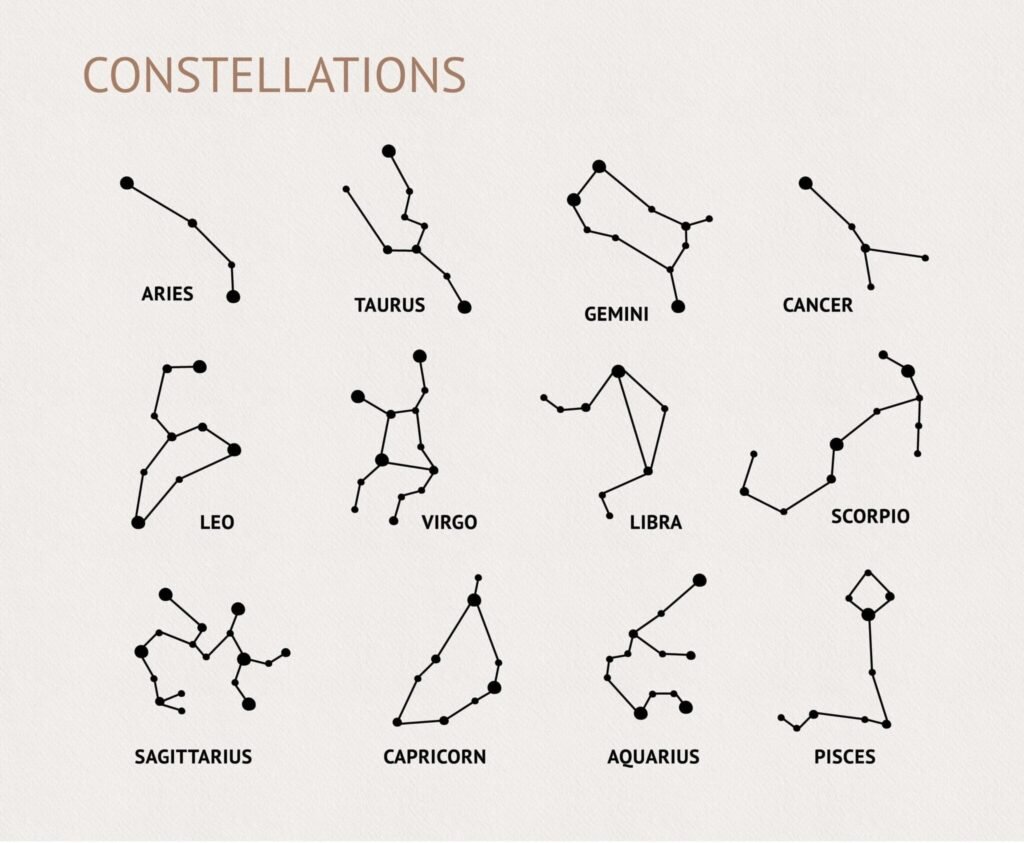
A constellation is a recognized region of the sky where stars appear to form shapes when viewed from Earth. Ancient observers imagined animals, hunters, birds, and mythological figures in these arrangements of stars. Modern astronomy officially recognizes 88 constellations, but the human relationship with them began thousands of years earlier.
The remarkable part is that constellations are not real structures in space. The stars within them are often separated by enormous distances. Humans connected them into patterns simply because of how they appear from our viewpoint on Earth.
Yet those imagined patterns became one of humanity’s oldest sky maps.
Constellations and Asterisms Are Not the Same Thing
Many people think every famous star pattern is officially a constellation. That is incorrect.
A constellation is an officially defined area of the sky. An asterism is simply a recognizable pattern formed by stars.
The best example is the Big Dipper.
The Big Dipper is not an official constellation. It is an asterism located inside Ursa Major.
Because the Big Dipper is bright and easy to recognize, many people mistake it for a full constellation. In reality, it is only part of a much larger celestial region.
Another famous asterism is Orion’s Belt, the three aligned stars inside Orion.
Astronomers use this distinction carefully because constellations divide the entire sky into mapped sections, while asterisms are simply visual patterns people notice easily.
The Same Stars, Different Civilizations, Different Stories
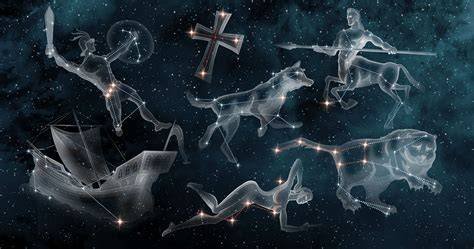
One of the most fascinating facts about constellations is that different civilizations looked at the same stars and imagined completely different figures.
The stars themselves never changed. Human interpretation did.
For example, the constellation known today as Orion was seen by the ancient Greeks as a giant hunter carrying a weapon across the sky. In ancient Egyptian traditions, parts of Orion were associated with Osiris, the god connected with the afterlife.
In Indian astronomy, some stars of Orion are linked with the Nakshatra system rather than the Greek mythological figure. Ancient Chinese astronomers divided the sky into entirely different star regions and symbolic structures, many related to imperial courts, dragons, or celestial animals.
Even the bright star cluster Pleiades received different meanings around the world:
- Greeks described them as the Seven Sisters
- Japanese tradition calls them “Subaru”
- In Indian astronomy they are connected with Krittika
- Indigenous cultures in Australia linked them with ancestral stories and seasonal changes
This reveals something important: constellations are not discoveries in the scientific sense. They are cultural interpretations layered onto the same sky.
Before GPS, Constellations Guided Entire Civilizations
Today, navigation depends heavily on satellites and digital systems. But for most of human history, the stars were the most reliable guide available.
Sailors crossing oceans depended on constellations to determine direction. In the Northern Hemisphere, navigators used the North Star, Polaris, which lies close to Earth’s rotational axis.
Polaris can be located using the stars of the Big Dipper inside Ursa Major. By tracing an imaginary line through the outer stars of the dipper, observers can point almost directly toward Polaris.
In the Southern Hemisphere, travelers relied on Crux to estimate south.
Arab navigators crossing deserts, Polynesian sailors traveling across the Pacific Ocean, and European explorers sailing between continents all used celestial navigation long before electronic tools existed.
This was not guesswork. Skilled navigators memorized star positions with extraordinary precision. Some Polynesian navigators could travel thousands of kilometers across open ocean using wave patterns, winds, and constellations together.
Modern GPS may feel advanced, but the first global navigation system was the night sky itself.
How Mobile Apps Recognize Constellations Today
The relationship between humans and constellations has changed dramatically in the smartphone era.
Modern astronomy apps use a phone’s GPS, gyroscope, compass, and camera orientation to identify stars and constellations in real time. When a user points the phone toward the sky, the app compares the viewing angle with astronomical databases and overlays constellation names directly onto the screen.
Apps such as Sky Map and Star Walk 2 can identify planets, satellites, star clusters, and constellations instantly.
What once required years of observation can now happen in seconds.
Yet these apps still rely on the same celestial positions humans tracked manually for centuries. Technology changed the method, but the sky remained the same.
Conclusion
Constellations are more than patterns of stars. They are records of how humans understood the universe before modern science fully explained it.
Different civilizations looked at the same sky and created different meanings from it. Sailors trusted constellations to survive long voyages. Ancient scholars tracked seasons through them. Today, astronomy apps identify them instantly with artificial intelligence and satellite positioning.
The stars themselves are distant and unrelated, but human imagination connected them into stories powerful enough to survive thousands of years.
Even now, when cities glow brighter than the night sky and GPS replaces celestial navigation, people still stop to look upward and search for familiar patterns among the stars.
That habit may be one of the oldest scientific instincts humanity has ever had.