Is Any Life Possible on Mars? Mars — The Mysterious Neighbor of Earth
Among all the planets in our solar system, Mars has remained one of the most fascinating worlds for scientists and astronomers. Often called the “Red Planet,” Mars appears reddish because its surface is covered with iron-rich dust. For centuries, people have wondered whether this distant world could support life.
Mars is the fourth planet from the Sun and is smaller than Earth, but many of its features look surprisingly familiar. A single day on Mars lasts about 24 hours and 39 minutes, making its rotation period very close to Earth’s. Its revolution around the Sun takes around 687 Earth days, which means one Martian year is nearly twice as long as a year on Earth.
Mars also has two natural satellites, Phobos and Deimos. These moons are small and irregular in shape, unlike Earth’s Moon. Scientists believe they may actually be captured asteroids trapped by Mars’ gravity long ago.
Because Mars shares some similarities with Earth — such as seasons, polar ice caps, and a day length close to ours — scientists consider it the most likely planet in the solar system where life might once have existed.
The Surface and Atmosphere of Mars
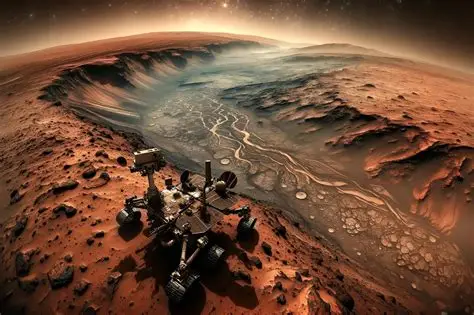
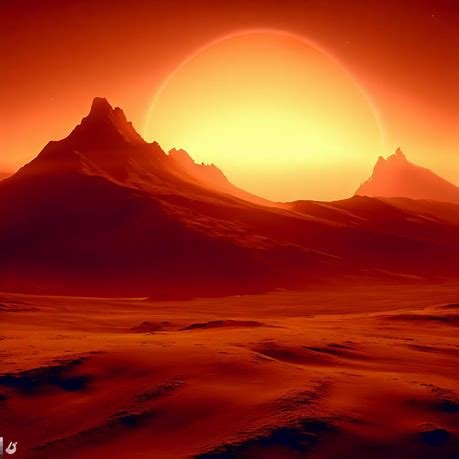
The surface of Mars is cold, rocky, and dry. Huge deserts stretch across the planet, mixed with giant volcanoes, deep valleys, and impact craters. One of the most famous features is Olympus Mons, the largest volcano in the entire solar system. Mars also contains Valles Marineris, a canyon system so massive that it would stretch across a large part of Earth.
Although Mars looks lifeless today, its surface contains strong evidence that liquid water once flowed there. Scientists have discovered dried river channels, lake beds, and minerals that form only in the presence of water. These discoveries suggest that ancient Mars may once have had a much warmer climate.
The atmosphere of Mars is extremely thin compared to Earth’s atmosphere. It is made mostly of carbon dioxide, with only tiny amounts of oxygen and water vapor. Because the atmosphere is so thin, it cannot trap enough heat to keep the planet warm. Average temperatures on Mars can fall below minus 60 degrees Celsius.
Another major problem is radiation. Earth is protected by a strong magnetic field, but Mars lost most of its magnetic protection billions of years ago. As a result, harmful solar and cosmic radiation directly reaches the Martian surface.
Dust storms are also common on Mars. Some storms become so large that they cover the entire planet for weeks, blocking sunlight and reducing temperatures even further.
Is There Any Possibility of Life on Mars?
The possibility of life on Mars depends largely on one important factor: water. Wherever liquid water exists on Earth, life is usually found in some form. Since Mars once had rivers, lakes, and perhaps even shallow seas, scientists believe the planet may have been habitable billions of years ago.
However, present-day Mars is a harsh environment. The cold temperatures, thin atmosphere, lack of oxygen, and strong radiation make survival difficult for complex organisms. Forests, animals, and human-like civilizations are extremely unlikely to exist there naturally.
Still, scientists do not completely rule out life. Research suggests that microscopic organisms may possibly survive beneath the Martian surface. Underground regions could protect microbes from radiation while trapping small amounts of liquid water and heat. On Earth, certain bacteria survive in deep underground rocks, frozen deserts, and volcanic environments, proving that life can adapt to extreme conditions.
Scientists are also studying methane gas occasionally detected in the Martian atmosphere. On Earth, methane is often produced by living organisms, although geological processes can also create it. This has made methane one of the most debated clues in the search for Martian life.
So far, no direct evidence of life has been discovered on Mars. But many researchers believe that if life ever existed there, it was probably microscopic rather than advanced.
Missions That Support the Possibility of Life on Mars
Several space missions have focused specifically on studying whether Mars could support life.
Viking Missions
The Viking 1 and Viking 2 missions in the 1970s were the first spacecraft to successfully land on Mars and perform biological experiments on Martian soil. Although the results were unclear, these missions began the modern scientific search for life on Mars.
Curiosity Rover
NASA’s Curiosity rover discovered organic molecules in Martian rocks and found evidence that ancient Mars once had conditions suitable for microbial life. Curiosity also confirmed that Gale Crater once contained water for long periods.
Perseverance Rover
The Perseverance rover is currently exploring Jezero Crater, which scientists believe was once an ancient lake. The rover is collecting rock samples that may later be brought back to Earth for detailed study. These samples could contain chemical signs of ancient microbial life.
Mars Orbiter Mission (Mangalyaan)
India’s Mars Orbiter Mission, launched by ISRO, studied the Martian atmosphere and surface from orbit. The mission helped scientists better understand methane levels and atmospheric conditions around Mars.
Ingenuity Helicopter
The small helicopter Ingenuity proved that powered flight is possible on Mars despite its thin atmosphere. Although it was mainly a technology experiment, it opened the path for future exploration of areas difficult for rovers to reach.
Conclusion
Mars is not just a cold desert planet; it is a world that carries traces of a very different past. Ancient rivers, underground ice, organic molecules, and signs of past water all suggest that Mars may once have supported simple life forms.
Today, the planet remains hostile for humans and most known organisms, but the possibility of microbial life beneath the surface still keeps scientists searching. Every rover, orbiter, and future mission brings humanity one step closer to answering a question that has existed for centuries: