Mars — The Planet That Keeps Humanity Curious
The Solar System and the Red Planet
Our solar system is a vast family of planets, moons, asteroids, and comets held together by the gravity of the Sun. Eight major planets move around the Sun in fixed paths, each with its own atmosphere, climate, and history. Some planets are made mostly of gas, while others are rocky worlds with mountains, valleys, and volcanoes. Among all of them, Mars has always attracted special attention because it appears more Earth-like than any other planet in the solar system.
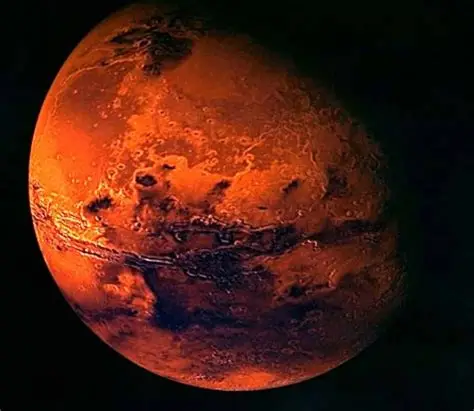
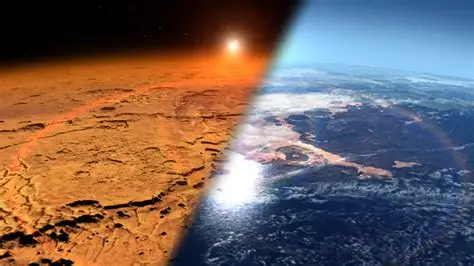
Mars is the fourth planet from the Sun and is often called the “Red Planet” because of the iron-rich dust covering its surface. From Earth, it shines with a reddish color in the night sky, making it visible even without a telescope. Although Mars is smaller than Earth, it contains giant volcanoes, deep canyons, frozen polar caps, and powerful dust storms. Scientists believe that billions of years ago, Mars may have had rivers, lakes, and possibly even an ocean. This possibility transformed Mars from a distant planet into one of the biggest scientific mysteries in space exploration.
Famous Research and Missions on Mars
The study of Mars has involved decades of missions from different space agencies. Each mission revealed something new about the planet’s atmosphere, surface, and history.
Mariner Missions — The First Close Images
In the 1960s, NASA’s Mariner 4 became the first spacecraft to successfully fly past Mars and send close-up pictures back to Earth. Before this mission, many people imagined Mars as a world filled with canals and vegetation. The images instead showed a dry and cratered surface.
.
Viking Missions — The First Successful Landing
The Viking 1 and Viking 2 missions in the 1970s became the first successful spacecraft to land on Mars and operate for a long period. These missions carried experiments designed to search for signs of life in Martian soil. Although no confirmed evidence of life was found, the missions completely changed our understanding of the planet.
Mars Pathfinder and Sojourner Rover
In 1997, NASA sent Mars Pathfinder along with the small Sojourner rover. It proved that robotic vehicles could move across the Martian surface and study rocks directly. This mission also sent thousands of images that fascinated people around the world
Spirit and Opportunity
The twin rovers Spirit and Opportunity were launched in 2003 to search for evidence of ancient water. Opportunity operated far longer than expected and discovered minerals that form only in the presence of water, strengthening the theory that Mars once had wet conditions.
Curiosity Rover
The Curiosity rover landed in 2012 and became one of the most advanced laboratories ever sent to another planet. Curiosity discovered organic molecules and studied the chemistry of Martian rocks and atmosphere. Its findings suggested that ancient Mars may once have supported microbial life.
Perseverance and Ingenuity
NASA’s Perseverance rover reached Mars in 2021 with the goal of searching for signs of ancient life and collecting rock samples for future return missions. Along with it came Ingenuity, the first helicopter to achieve powered flight on another planet. This small helicopter proved that flying in Mars’ thin atmosphere is possible.
India’s Mars Orbiter Mission
India also entered Mars exploration through Mars Orbiter Mission, also called Mangalyaan. Launched by ISRO in 2013, it made India the first Asian nation to reach Mars orbit successfully and the first country to do so on its first attempt. The mission studied the Martian atmosphere and surface while showing that complex interplanetary missions could be achieved at comparatively low cost.
Amazing and Surprising Facts About Mars
Olympus Mons — The Largest Volcano in the Solar System
Mars is home to Olympus Mons, the tallest volcano known in the solar system. It rises about 22 kilometers high, nearly three times taller than Mount Everest. Because Mars has weaker gravity and no moving tectonic plates like Earth, volcanoes were able to grow to enormous sizes over millions of years.
Valles Marineris — A Canyon Bigger Than Anything on Earth
Mars contains a gigantic canyon system called Valles Marineris. It stretches for nearly 4,000 kilometers and reaches depths of around 7 kilometers. If placed on Earth, it would extend across an entire continent.
Blue Sunsets on Mars
Sunsets on Earth usually appear orange or red, but on Mars the opposite happens. Fine dust particles in the Martian atmosphere scatter red light differently, causing sunsets to appear bluish near the Sun. This creates one of the strangest skies in the solar system.
Dust Storms Can Cover the Entire Planet
Mars experiences enormous dust storms, some of which become so large that they cover the whole planet for weeks. These storms can block sunlight and affect solar-powered spacecraft operating on the surface.
A Day on Mars Is Similar to Earth
One Martian day, called a “sol,” lasts about 24 hours and 39 minutes. This similarity makes Mars more suitable for future human missions compared to planets with extremely long or short days.
Mars Has Frozen Water
Scientists have discovered large amounts of water ice beneath the Martian surface and at its polar regions. Some underground ice deposits are massive enough to fill entire lakes if melted. This discovery is important because water is essential for both life and future human exploration.
Conclusion
Mars is more than just another planet in the night sky. It is a world that preserves clues about the early history of planets, climate change, and possibly life itself. From giant volcanoes and frozen deserts to robotic explorers moving across its surface, Mars continues to challenge human curiosity and imagination.
Every mission sent to Mars answers one question while creating many new ones. That is why the Red Planet remains at the center of modern space exploration. Humanity is not only studying Mars to understand another world — it is also studying Mars to better understand Earth and our own future in space.