let's get more about the nearest star and the centre of solar system
1. Formation: A Star Born from Collapse
Around 4.6 billion years ago, a region inside a cold molecular cloud lost its internal balance and began collapsing under gravity. Evidence from isotopes in meteorites suggests that a nearby supernova may have triggered this collapse. As the cloud contracted, it spun faster and flattened into a rotating disk. Most of the mass accumulated at the center, forming a protostar—the early Sun.
When the core temperature crossed roughly 10 million Kelvin, hydrogen nuclei began to fuse. That moment marks the Sun’s entry into the main sequence, where it has remained stable for billions of years. Nearly all the material—about 99.86% of the solar system’s mass—ended up in the Sun, leaving the remaining fraction to form planets and smaller bodies. To put that in scale: the Sun is about 330,000 times more massive than Earth.
2. Nuclear Fusion: Energy from Mass Conversion
At its core, the Sun runs on the proton–proton chain reaction. Four hydrogen nuclei combine through a sequence of steps to form one helium nucleus. The mass of the helium produced is slightly less than the original hydrogen; the missing mass is released as energy.
Each second, the Sun converts about 600 million tons of hydrogen into helium. Around 4 million tons of mass are transformed directly into energy in that same second. The total energy output—about 3.8×10263.8 \times 10^{26}3.8×1026 watts—is so large that in one second, the Sun emits more energy than humanity has used in its entire history.
This energy does not escape instantly. Photons generated in the core scatter repeatedly in the dense interior, taking thousands to millions of years to reach the surface. Only then do they stream outward as visible light, ultraviolet radiation, and other wavelengths.

3. Solar Anatomy: Layers and Their Roles
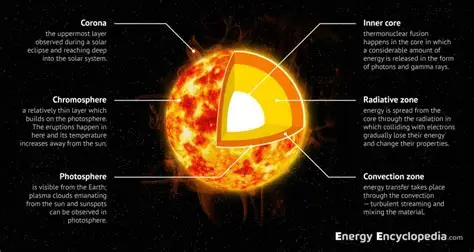
Core (0–25% of radius):
The fusion region, with temperatures near 15 million Kelvin and densities about 150 times that of water. All energy originates here.
Radiative Zone (25–70%):
Energy moves outward through radiative diffusion. A photon’s path is constantly interrupted—absorbed and re-emitted—making this region extremely slow for energy transfer.
Convective Zone (70–100%):
Here, plasma motion replaces radiation as the dominant transport mechanism. Hot material rises, cools near the surface, and sinks again. These cycles produce granules on the solar surface, each roughly the size of a continent.
Photosphere (~500 km thick):
The visible surface, at about 5,800 K. Sunspots appear here as darker regions, typically 1,500 K cooler than their surroundings, caused by concentrated magnetic fields.
Chromosphere:
A thin, irregular layer where temperatures begin rising again. It becomes visible during solar eclipses as a faint reddish rim due to hydrogen emission.
Corona:
The outer atmosphere, extending millions of kilometers into space, with temperatures exceeding 1 million Kelvin. Instruments aboard Aditya-L1 are designed to study this region continuously, while Parker Solar Probe travels closer to the Sun than any spacecraft before it, sampling the solar wind and magnetic environment directly.
4. Misconceptions About the Sun and Earth
- “The Sun burns like fire.”
Fire is a chemical reaction requiring oxygen. The Sun’s energy comes from nuclear fusion, where atomic nuclei combine under extreme pressure and temperature. - “Earth is closer to the Sun in summer.”
Earth’s orbit is slightly elliptical, but seasons are controlled by axial tilt. In fact, Earth reaches its closest point to the Sun in early January. - “The Sun is constant and unchanging.”
The Sun follows an approximately 11-year solar cycle. Sunspot numbers rise and fall, and periods of high activity produce solar flares and coronal mass ejections that can interfere with satellites, GPS signals, and power systems.
5. Why the Sun Matters: Beyond Illumination
The Sun is the central gravitational force of the solar system, holding planets in stable orbits. Its radiation drives atmospheric circulation, ocean currents, and the water cycle on Earth. Without this continuous energy input, Earth’s surface temperature would drop to about –270°C, close to the temperature of space.
Photosynthesis converts solar energy into chemical energy, forming the base of nearly all food chains. Even fossil fuels—coal, oil, natural gas—are stored solar energy from ancient biological systems.
Modern systems are also tied to solar behavior. Variations in solar activity can disturb Earth’s magnetic field, affecting satellites, communication networks, and power grids. Monitoring these changes is no longer just scientific curiosity; it is a practical necessity.
6. A Grounded Ending
The Sun maintains its structure through a precise balance: gravity pulls inward while energy from fusion pushes outward. This equilibrium has held for billions of years, allowing life to develop on at least one planet in its orbit.
Yet the Sun is not static. Its magnetic field shifts, its surface evolves, and its influence extends far beyond visible light. Understanding it is less about describing a star and more about understanding a system that shapes environments, technologies, and long-term planetary stability. The closer observations get—through missions and instruments—the more the Sun appears not as a constant backdrop, but as an active, measurable force that still sets the conditions for everything around it.