Neighbour Galaxy Andromeda
1. Introduction — Structure, Scale, and Motion
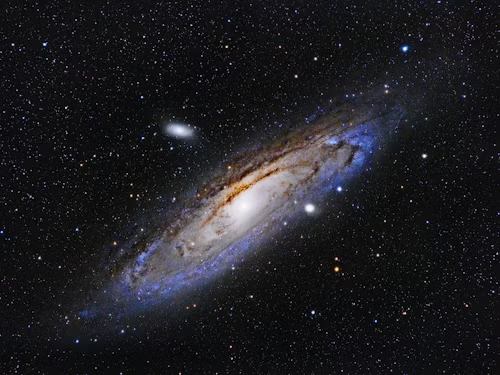
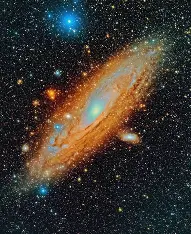
The Andromeda Galaxy (M31) is the nearest large galaxy to the Milky Way and the most distant object visible to the unaided eye under dark skies. It is classified as a barred spiral galaxy, with a rotating disk, a dense central bulge, and spiral arms embedded with gas, dust, and young stars.
It lies in the direction of the constellation Andromeda at a distance of about 2.5 million light-years. Its diameter extends to roughly 220,000 light-years, making it significantly larger than the Milky Way. Estimates suggest it contains close to one trillion stars.
Spectroscopic measurements show that Andromeda is moving toward the Milky Way at nearly 110 km/s. This motion is not random—it reflects the gravitational interaction within the Local Group, indicating a future merger rather than continued separation.
Data Snapshot — Key Physical Parameters
| Property | Value |
|---|---|
| Distance from Earth | ~2.5 million light-years |
| Diameter | ~220,000 light-years |
| Stellar Population | ~1 trillion stars |
| Relative Velocity | ~110 km/s (toward Milky Way) |
| Galaxy Type | Barred Spiral |
2. Discovery, Measurement, and the Question of Life
The earliest known record of Andromeda appears in 964 CE, when the Persian astronomer Abd al-Rahman al-Sufi described it as a faint cloud. Its true scale remained unresolved until the 20th century.
The turning point came when Edwin Hubble identified Cepheid variable stars within Andromeda. By measuring their brightness variation, he calculated a distance far beyond the Milky Way, demonstrating that Andromeda is an independent galaxy. This result established that the universe contains multiple galaxies, not a single stellar system.
Modern observations using the Hubble Space Telescope resolved millions of individual stars through the PHAT survey, while the James Webb Space Telescope has begun mapping dust lanes and star-forming regions in infrared wavelengths.
On the question of life, Andromeda’s scale implies billions of planetary systems. The outer disk contains regions where star density and radiation levels are comparable to the Milky Way’s habitable zones. However, no biosignatures or atmospheric detections exist at that distance. The limitation is observational: current instruments cannot isolate Earth-sized planets in another galaxy.
3. Missions and Observational Programs
No direct space mission has been sent to Andromeda. At a distance of millions of light-years, even the fastest spacecraft would require tens of millions of years to arrive. The study of Andromeda is therefore entirely based on light—across optical, infrared, and radio wavelengths.
The Hubble Space Telescope carried out the Panchromatic Hubble Andromeda Treasury (PHAT), producing a high-resolution map of a large section of the galaxy’s disk. The James Webb Space Telescope extends this work by penetrating dust-obscured regions, revealing star formation otherwise hidden.
Ground-based systems such as the Keck Observatory provide spectroscopic data, allowing astronomers to measure stellar velocities and chemical composition. These measurements show that Andromeda has a more massive and extended halo than earlier models suggested.
A notable structural feature is its star-forming ring located about 10 kiloparsecs from the center, likely shaped by past interactions with smaller galaxies.
4. Scientific Interpretation — What the Evidence Shows
Andromeda carries visible evidence of past mergers. Its halo contains streams of stars—remnants of smaller galaxies absorbed over time. This supports the hierarchical model of galaxy formation, where large galaxies grow through repeated accretion.
One unusual feature is its double nucleus, observed in high-resolution imaging. Rather than two separate cores, it is understood as a single nucleus with stars distributed in an eccentric disk around a central supermassive black hole.
The future interaction between Andromeda and the Milky Way is often described as a “collision,” but this can be misleading. The distance between stars is so large that direct stellar collisions are extremely unlikely. Instead, gravitational forces will reshape both galaxies—stretching disks, redistributing gas, and eventually forming a new elliptical system.
Researchers use Andromeda as a comparative model: it provides an external view of a galaxy similar to the Milky Way, allowing structures like spiral arms, halos, and bulges to be studied without our internal observational limits.
5. Conclusion — What Remains Open
The Andromeda Galaxy is close enough to resolve star by star, yet distant enough to represent galaxies beyond our own. That combination makes it a reference system for testing models of galaxy structure, evolution, and interaction.
Its motion toward the Milky Way is already measurable. Its past mergers are already recorded in its halo. Its internal structure is mapped in increasing detail. What remains limited is not the object itself, but the reach of observation—especially when extending similar precision to galaxies far beyond the Local Group.
If Andromeda can now be studied at the level of individual stars, the next constraint is distance: how far outward can this level of detail be sustained before galaxies return to unresolved points of light