origin of universe
A Universe Once Compressed
Imagine everything that exists today—galaxies, stars, planets, even space itself—compressed into an unimaginably small, dense state. Not a “ball” in the ordinary sense, but a condition where our familiar ideas of size and distance lose meaning. This is where the story of the universe begins.
There was no space around it, no “outside.” Just an extreme state of energy and density. And then, something changed.
The Expansion We Call the Big Bang
The term Big Bang can be misleading. It wasn’t an explosion into empty space—it was space itself expanding.
In the earliest moments, the universe was incredibly hot and dense. As it expanded, it cooled. Within fractions of a second, fundamental particles formed. A few minutes later, the first simple nuclei—mostly hydrogen and helium—came into existence.
But the universe was still opaque. Light could not travel freely yet. It was trapped in a dense, glowing plasma, constantly scattering off charged particles.
The First Light: Cosmic Microwave Background
Roughly 380,000 years later, the universe had cooled enough for electrons and nuclei to combine into neutral atoms. This moment—called recombination—changed everything.
Light was finally able to move freely.
That ancient light still exists today as the Cosmic Microwave Background. It is not just a relic; it is a snapshot of the universe at the moment it first became transparent. When we observe it, we are looking back to the earliest visible chapter of cosmic history.
The Long Silence: Cosmic Dark Ages
After the release of the first light, the universe entered a quieter phase often called the Cosmic Dark Ages.
There were no stars yet. No galaxies. Just vast clouds of hydrogen and helium, slowly evolving under the influence of gravity. The universe was dark—not empty, but without luminous sources.
During this time, tiny irregularities in matter distribution—seeded in the early universe—began to grow. Gravity started to gather matter into denser regions.
When Gravity Took the Lead
Gravity is subtle, but relentless. Over millions of years, it amplified small density differences into larger structures. Regions with slightly more matter pulled in even more, growing into dense clouds.
Eventually, these clouds became heavy and compact enough for something remarkable to happen: the birth of the first stars.
The First Stars Ignite
The first generation of stars, often referred to as Population III stars, were unlike the ones we see today. Made almost entirely of hydrogen and helium, they were massive, short-lived, and intensely bright.
When these stars ignited, they ended the cosmic darkness.
Their light began to reionize the surrounding hydrogen, making the universe transparent again in a new way. They also forged the first heavy elements—carbon, oxygen, iron—through nuclear fusion, seeding the cosmos with the ingredients necessary for planets and, eventually, life.
From Stars to Galaxies
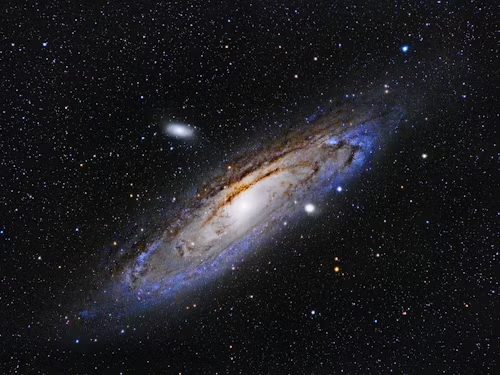
Stars did not remain isolated. Under gravity, they grouped together, forming the earliest galaxies. Over billions of years, these galaxies merged, evolved, and structured themselves into the vast cosmic web we observe today.
Galactic evolution is not a finished story—it is ongoing. Every galaxy carries a record of its past: collisions, star formation, and transformation over time.
Why This Story Still Matters
This is not just a story about the past. It directly shapes how we understand the present universe.
- Galactic evolution explains why galaxies differ in size, shape, and activity.
- The distribution of matter reveals the role of unseen components like dark matter.
- The chemical elements in our bodies trace back to early generations of stars.
Modern instruments are now pushing this story further.
The James Webb Space Telescope is observing some of the earliest galaxies ever formed. It is not just confirming existing theories—it is challenging them. Some galaxies appear more mature, earlier than expected, raising new questions about how quickly structure formed after the Big Bang.
A Story Still Unfolding
The origin of the universe is not a closed chapter. It is a framework—constantly tested, refined, and sometimes questioned.
We began with a universe that had no stars, no structure, no light. Today, we stand inside a cosmos filled with galaxies, complexity, and history.
And yet, the deeper we look, the clearer it becomes: we are still at the beginning of understanding how it all truly began.